
A structured engineering BOM
Build from components to assemblies to the complete robot. Track quantities, reference designators, where-used, mass, and lead time.
Explore the capabilityRobotics · An example workflow
Connect engineering structure with the life of each machine. Keep BOMs, revisions, serial configurations, and service history in one product model.
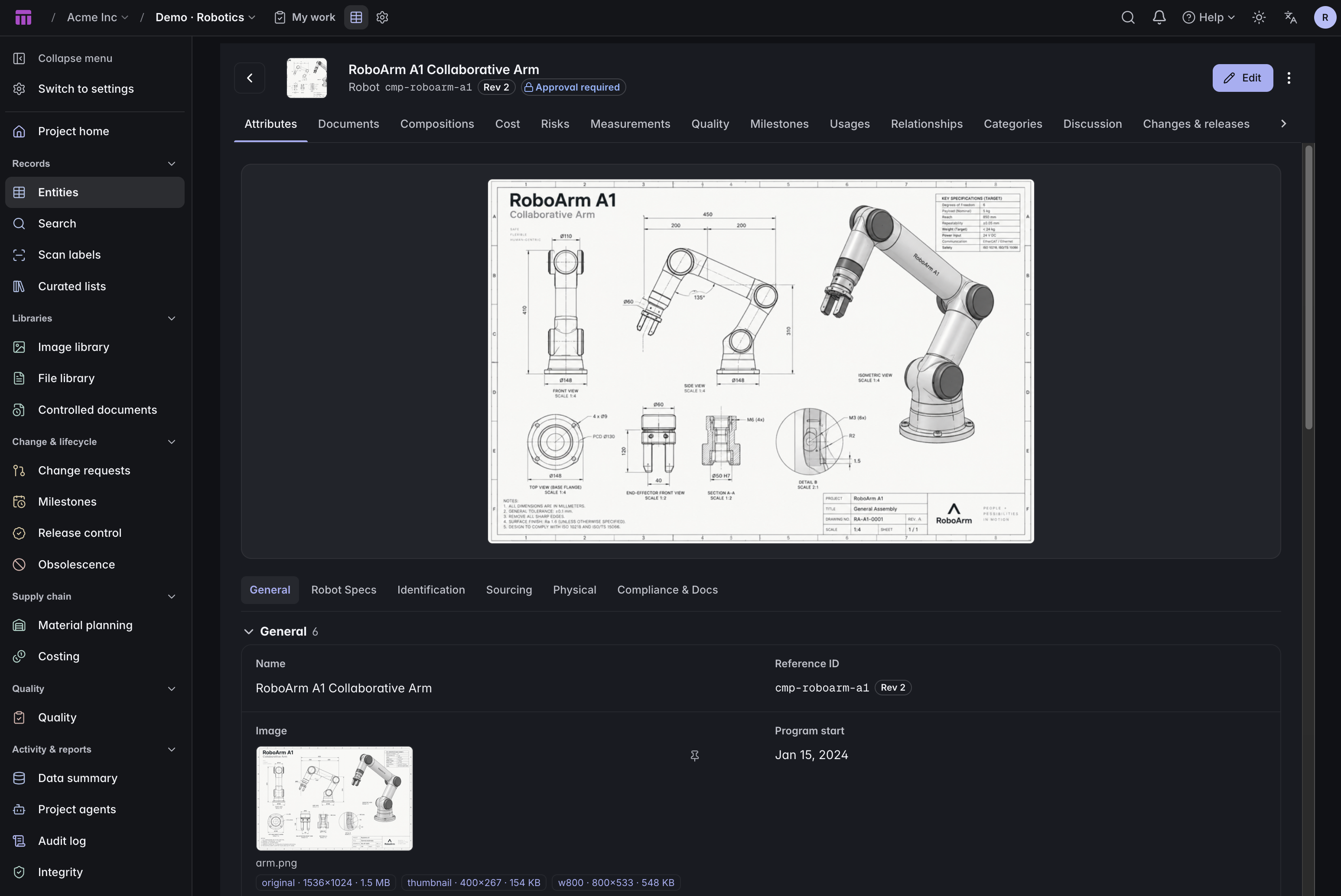 Click to enlarge ↗
Design, build, and service
Build from components to assemblies to the complete robot. Track quantities, reference designators, where-used, mass, and lead time.
Explore the capabilityKeep the unit’s customer, site, commissioning date, and firmware and software revisions alongside its configuration.
Explore the capabilityRecord duty hours and service visits against each unit. Keep configuration changes and spare-part references connected to the machine’s history.
Explore the capabilityReview changes to the design, then preserve the exact released assembly configuration. Follow rollout work and configuration drift against installed units.
Explore the capabilityYour model, your workflow
An AMR and a robot arm can share a Component base type while keeping their own fields and BOMs. Polymorphic base types let you work across related products without losing the details of each one.
ManyRows supports products across industries. Use a starter template, extend the model, or build your own from an empty project.
Explore the modelling toolsA closer look
Yes. Each unit can carry its firmware and software revision as fields, with changes recorded in its history. You can filter records by those values.
The Robot record holds the design, BOM, and approved revisions. A Robot Unit represents an individual machine, with its serial number, configuration, and service history.
ManyRows manages the engineering and service record. Live telemetry can stay in your monitoring system while ManyRows holds the configuration and recorded service history.
Review the plans and included capacity on the pricing page. You can start with a 7-day trial without a card.
More ways to use ManyRows