About ManyRows
The PLM for teams whose spreadsheets became the system.
Real product development still runs on spreadsheets and a shared drive. Not because anyone thinks that is a good idea, but because the tools that fix it are priced and shaped for companies with a procurement department. Everyone knows which file is wrong. Nobody can say which one is right.
Why ManyRows exists
ManyRows started in 2025 as product lifecycle management for teams that had outgrown spreadsheets long before they could justify a six-figure PLM rollout.
The name works two ways. The literal one is rows of data, because that is what the product is made of. The truer one is relational: one to many. A parent to its components, a style to its colourways, an order to its sizes. That one-to-many edge is the thing a spreadsheet cannot hold on to, and holding on to it is most of what a PLM is for.
The engine underneath came out of years spent building content platforms and app builders, which is where the hard part was already solved: a data model that bends to a garment, a formula and a machined part without falling apart. The obvious move with an engine like that is to point it at another generic app builder. We weren't interested. There are plenty of those, they all demo beautifully, and not one of them would have helped the teams we watched struggle, because the work was never “store some rows” and always “which revision did the factory build, and who approved it”. If the category itself is new to you, start with what PLM means.
The distinction that matters
A PLM, not a database with a good interface.
A tool that can model anything leaves you to invent change control, revisions and a bill of materials yourself, and that is the entire job. ManyRows starts a layer above it. You define the types and the fields; what sits under them already knows the parts nobody wants to build twice.
- Multi-level BOM What goes into what, opened level by level, with costs and quantities that roll up and a where-used view that reads backwards from a single bolt.
- Revisions and change control Frozen revisions, and what a change request has to guarantee when two people edit the same record and one of them is wrong.
- The awkward specifics Size specs that grade across a run, formulas with co-products and yield, effectivity dates, lot genealogy. The parts a generic tool leaves you to invent.
What that looks like in the product
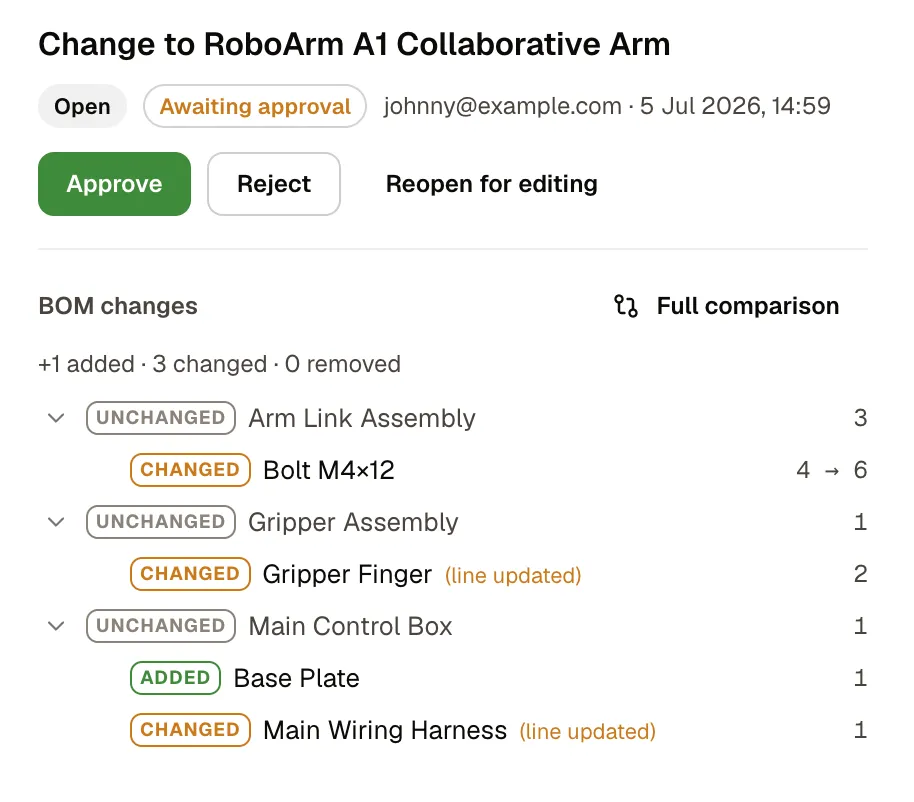
A change request is a working copy, not a comment thread. It carries every edit it touches, shows which BOM lines moved and by how much, and applies as one act or not at all. Governance is the part a flexible database cannot hand you.
Take the tour for the rest of it.
How we work
Four things on this site are unusual for the category. They are the same decision made four times: keep the buying process as honest as the product record is supposed to be.
- [01] Pricing on a page, not in a quote
Every plan and every limit is on the pricing page, so you can work out your bill unaided instead of booking a call to learn what it costs. Traditional PLM is sold on a quote; we would rather be compared on a number you can read today.
- [02] Your gap can become the roadmap
Custom development is included on Team and above, within reason. When the gap is something ManyRows should have had anyway it ships to every customer rather than sitting in a branch for you. The limit is honest too: no one-offs only you would use, and you get that answer in a sentence.
- [03] Comparisons that sometimes say buy the other one
Every competitor page names the cases where that product is the better answer. If Arena or Oracle or Propel fits you better, the fastest way to find that out should be our own website rather than a rollout six months from now.
- [04] A roadmap set by real products, not press releases
Features get built because a real product needed them, not because a competitor announced one. That is why the toolkit is deep in odd places, like size specs with grading and formulas with co-products, and deliberately absent in others.
What happens to your data
The fair question to ask any PLM vendor holding your product data is how you would get it back. Ask us, and ask the funded ones a version of it too, because “we get acquired and the product is sunset” is a real thing that happens in this category.
Our answer is that your exit is built in and you can test it today. The whole project exports as a bundle you can re-import somewhere else, the schema as well as the records, over the same API you use every day. Not a CSV of rows with the model thrown away. No support ticket, no retention call. If ManyRows stops being the right answer, for any reason, you leave with the thing you built.
That is deliberate. We would rather compete on whether the product is good than on how painful it is to leave.
Common questions about ManyRows
- What is ManyRows?
- ManyRows is a product lifecycle management (PLM) platform. It holds what a product is made of, which revision is current, and what changed: multi-level bills of materials, revisions, change requests with approvals, suppliers and costs, in one governed system with a REST API. What PLM means
- Who is ManyRows for?
- Teams that have outgrown spreadsheets and a shared drive, and need the product record to be something more dependable than the file everyone hopes is current. It suits companies with no PLM administrator, because the system is configured by the people who use it rather than implemented by a consultant.
- What kinds of products can ManyRows model?
- Anything composed of other things. The data model is typed rather than industry-locked, so apparel with size specs and colourways, food and cosmetics with formulas and co-products, and hardware with multi-level assemblies all run on the same platform. See it in a real system
- Is ManyRows a PLM or just a flexible database?
- A PLM. You define your own types and fields, but the platform underneath already understands multi-level bills of materials, revisions, effectivity dates and what a change request has to guarantee when two people edit the same record. A generic database leaves you to invent all of that yourself, which is the entire job.
- Can I export my data out of ManyRows?
- Yes, at any time and without asking. A whole project exports as a bundle containing the schema as well as the records, over the same public API you use every day, and can be re-imported elsewhere. There is no support ticket and no retention call in the way.
- How much does ManyRows cost?
- Plans, limits and prices are published, including a free tier and a trial that needs no card. There is no quote process and no mandatory demo before you can see a number. See ManyRows pricing
The free plan needs no card, and the export you just read about works on it too.