Electronics

The board is finished. The parts are not.

A schematic can be right for a decade; its parts cannot. Microcontrollers go EOL mid-production, a certificate lapses with a vendor's product change notice, and the buyer asks which substitute was ever actually approved for line C7. ManyRows keeps the design and the supply reality in one place, each telling the truth about the other.

Two speeds, one record

The design, and the supply

The BOM changes when you decide it should. The parts under it change when the market decides. Keeping both honest in one system is most of what electronics PLM is for.

The design

Product and PCBA

The thing you drew. Boards under a product, parts under boards, every line with its reference designators.

  • A multi-level BOM: product to board to part, quantitied, with refdes on the component lines
  • Unit cost rolled up the tree from every part's price, exportable as CSV
  • Where-used in both directions: which boards eat this part
  • Change-controlled at the top: a sellable product does not change without an approval
The supply

Part

The thing you can actually buy this quarter. Manufacturer, MPN, lifecycle, paperwork.

  • Manufacturer and manufacturer part number beside your internal part number
  • A lifecycle that admits the truth: Active, NRND, EOL, Obsolete
  • An EOL part names its successor, and every BOM still using it is listed
  • Compliance certificates attached to the part, each with a validity date
Sourcing risk

EOL is a when, not an if

Two mechanisms carry the whole story: a supersession chain for the part that is going away, and per-line approved alternates for the day the main source dries up. Both live on the records the buyer already looks at.

Obsolescence

The EOL chain

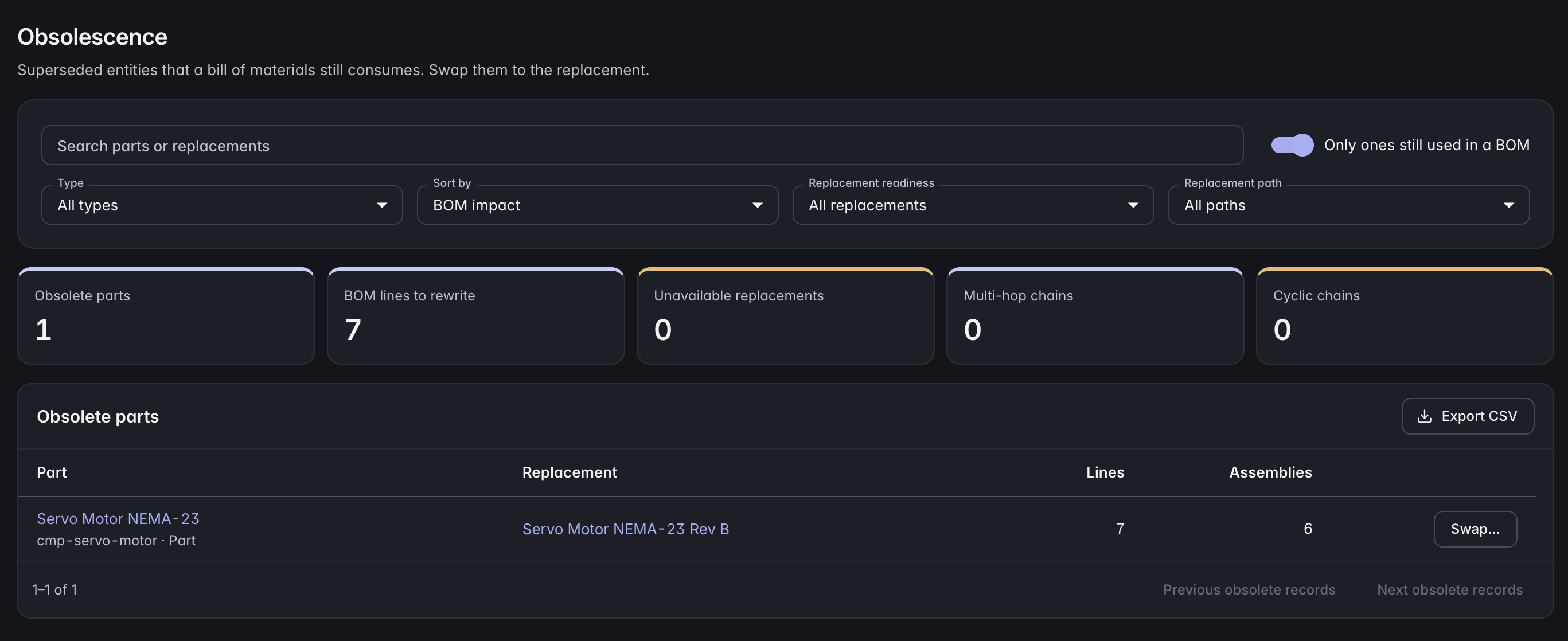
Mark a part EOL and point it at its successor. The Obsolescence page lists every part that is superseded and still consumed by a bill of materials, with a swap that walks the affected lines. The starter ships one mid-story: an EOL microcontroller, its successor, and the board that still lists it.

The AVL, per line

Approved alternates

Each BOM line carries its own list of approved substitute parts, across manufacturers. When the buyer cannot get the main part, the pre-approved answer is on the line itself rather than in someone's inbox from two years ago.

A saved Sourcing risk view keeps every NRND, EOL and Obsolete part one click from the grid, so the quarterly review is a filter, not an archaeology project.

Compliance paperwork

Certificates that know their own date

RoHS, REACH, UL, CE: each certificate is a record attached to the part it covers, with an issuer and a validity date. The date drives a status you can filter and facet the whole library by, and a shipped view keeps the ones that need attention in front of you.

ok
The certificate is valid and more than 30 days from its date. Nothing to do.
expiring
Inside the 30-day window. Time to chase the renewal, while the part still ships.
expired
The date has passed. The certificate is still on file, and every view says plainly that it no longer covers anything.

The starter ships the story mid-scene: the EOL microcontroller's RoHS certificate lapsed with the discontinuation notice, and the rest sit on the same expiry rail, each one a renewal date the platform is already watching.

One click

A working product line, already populated

The Electronics starter is a populated project: an industrial IoT gateway, four boards, and a parts library with its problems already visible, so you can click through the EOL chain and the cost rollup before deciding anything.

  • 136seed records, including 48 parts and 46 BOM lines
  • 8manufacturers behind the parts, plus distributors and POs
  • 4boards under a governed product, refdes on the component lines
  • 10compliance certificates, the lapsed RoHS already flagged

Plus a unit-cost rollup on every board, saved Sourcing risk and Expiring certificates views, and a check vocabulary shaped for boards: AOI, in-circuit test, functional test, first article.

When this is the wrong tool

If you want live distributor stock, pricing feeds and parametric part search, that is a components database; we hold what your team decided, not what the market is doing this hour. If you need your EDA tool writing the BOM directly into PLM through a plugin, we do not ship one; the indented BOM export every EDA tool produces is the bridge. And if your product is a regulated medical device and you are buying evidence for an audit, look at a vendor built around that. We make no regulatory certification claim. Better to say all of this now than after a migration.

Questions

Do you pull live lifecycle or market data from distributors?
No. ManyRows holds what your team knows and has decided: the lifecycle you have set, the alternates you have approved, the certificates you have on file. Teams that want live market feeds run a components database beside it, and the two answer different questions. Ours is: what did we decide, and which boards does it touch?
How do approved alternates work?
Every BOM line can carry a list of substitute parts approved for that line specifically, not for the part in general. A capacitor might have three interchangeable sources on a decoupling line and none at all in a filter where the dielectric matters. The line is the honest place for that decision, so that is where it lives.
What happens when a part goes EOL?
You set its lifecycle to EOL and point it at the replacement part. From then on the Obsolescence page shows it with a count of the BOM lines and assemblies still consuming it, and a swap tool that moves those lines to the successor. Nothing changes silently: if the parent product is change-controlled, the swap goes through an approval like any other edit.
Can I import an existing BOM?
Yes, two ways. A CSV import with column mapping and a preview, for flat part lists. And an indented BOM import, the level/quantity table every CAD and EDA tool can export, which builds the multi-level structure in one pass.
Is the cost rollup a real costing system?
It is a unit-cost rollup: every part carries a cost, and a board or product sums quantity times cost up the tree, with a CSV export and point-in-time snapshots. It answers what the bill of materials costs to build. It is not a quoting engine and does not know your volume price breaks.
What does it cost?
It is on the pricing page and you can work out your bill without talking to anyone. That is deliberate, and it is one of the clearer differences between us and most of this category.
Start free

Open the electronics starter

Spin up a project, pick Electronics / PCBA, and you are looking at a populated BOM with a live EOL problem in about a minute.

Start free Every feature PLM for robotics Compare